Gear Considerations
Why the discussion
We’re always wanting the best/shiniest stuff and overlanding is no exception. I’ll just provide some of the insight I’ve gained over the last several years and let you decide.
Vehicle
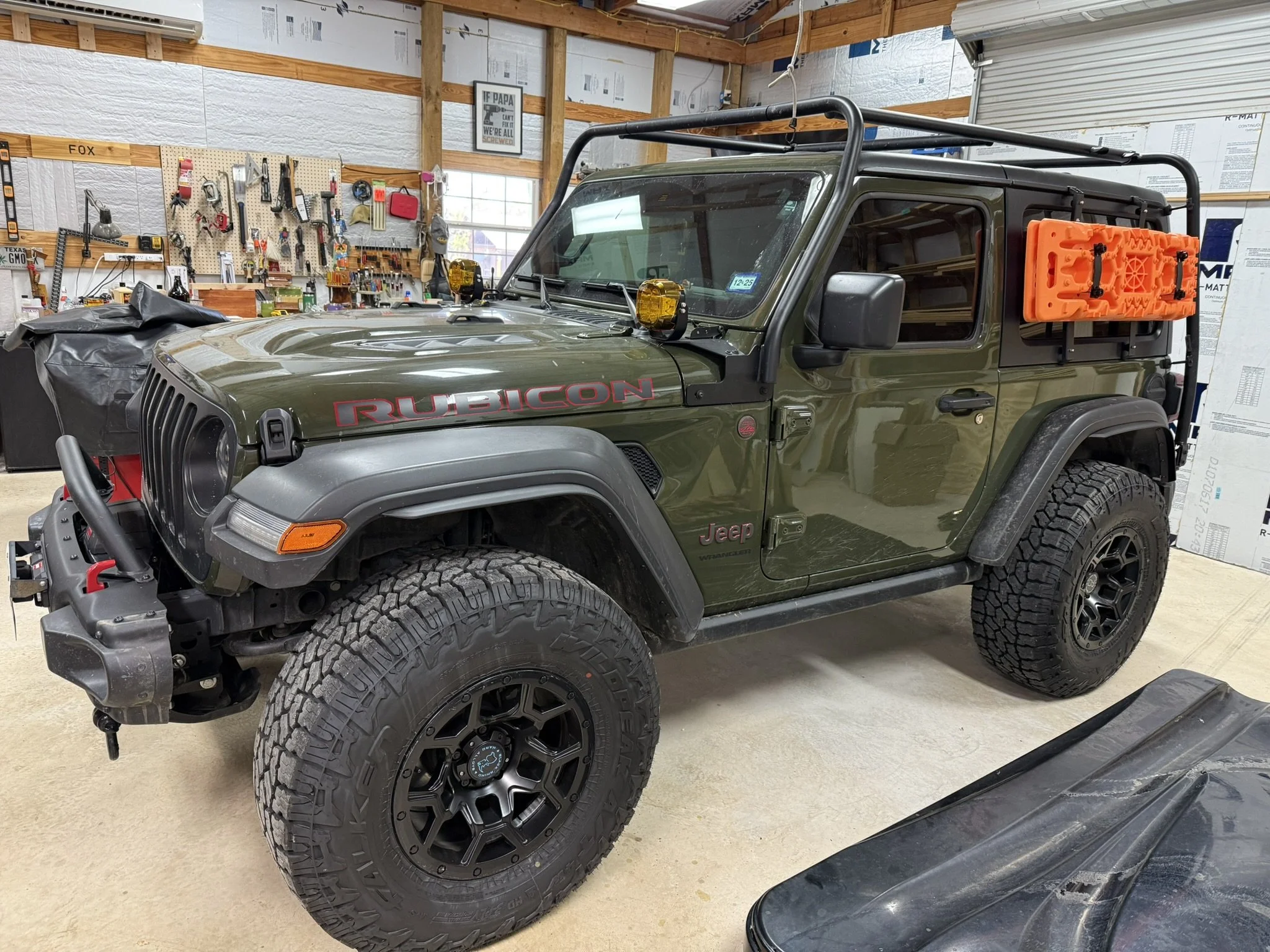
Jeep Rubicon JL 2-Door with Black Rhino wheels and 35” tires
Think about where you’re going to go, what the conditions are, and what you’re carrying. Paved roads at one end, rock crawling at the other. There are a lot of choices in between. I chose to drive a 2 door Jeep Rubicon JL. I’m the only one in it overlanding and didn’t think I’d need that much room. Yes, I could use some more room still. But the 2 door has a shorter wheel base and makes taking the switchbacks easier. The Jeep also has a more narrow width than many other offroad vehicles, making those tight trails easier to handle. Jeeps have solid axles that articulate over obstacles much better than independent suspension. Modifications that I’ve made to it:
Black Rhino Overland wheels, offset, with 35” Falcon Wildpeak A/T tires on them. The Rubicon came with 33s and can take up to 35s without any additional lift. The Rubicon spare tire mount is also a Mopar upgrade, and can handle the 35” spare after raising the center tail light. Be prepared to have some help changing tires: the combination of my Rhino wheels and Wildpeak 35” tires makes them 100 lbs. each.
Garvin Adventure rack system, to allow a RTT on top. When I bought my 2020 JL 2-door that was the only one available at the time.
Mopar air intake that required cutting through the hood for access.
Winch on the front bumper. The Rubicon came with the Mopar factory steel bumper capable of mounting a winch. I installed the Warn EVO 12 and it works great.
There are other vehicles to consider as well. Jeeps are not highway cruisers, so long stretches of highway are not as comfortable as in a vehicle with independent suspension. Full size pickups can have far more room but can’t fit well on many mountain trails and passes. Or shouldn’t be on them at all in some places. The most popular alternative to a Jeep is the Toyota Tacoma, better known as the Taco. The offroad version handles moderate trails well and has a width closer to the Jeep (78” vs. the Jeep’s 74”). There are some great Overlanding additions that make pickups and Jeep Gladiators a good choice. The Alu-Cab modular system for instance adds great storage and RTT options to pickup bed vehicles. Then there are the high-end offroad RV options such as the Rossmonster and Earth Roamer vehicles. These are built on F350+ platforms and run from $500,000 to $1,000,000 each. But those seem more like glamping options of overlanding to me and not something the average Joe can afford.
Tent
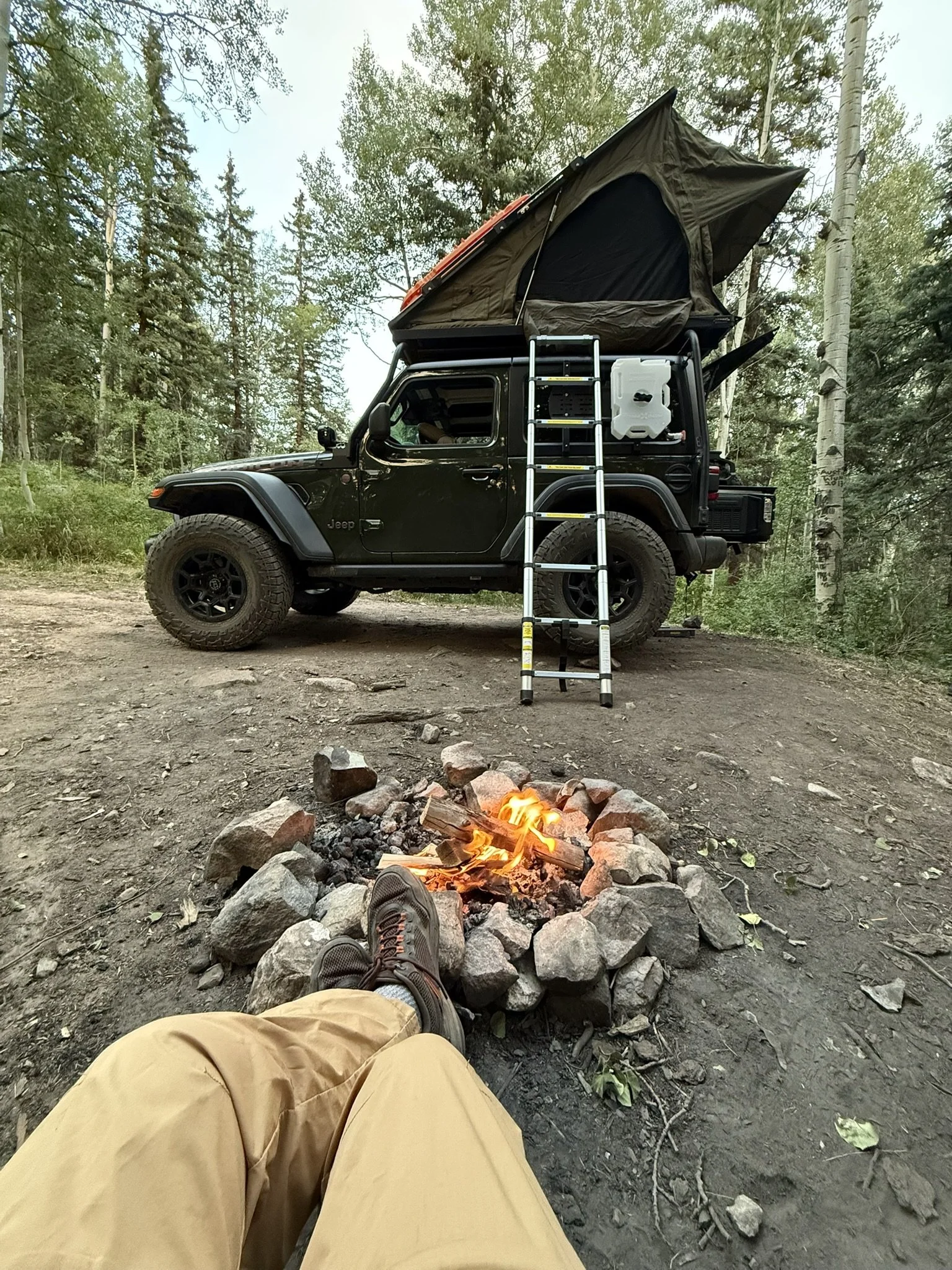
Chilling before getting in my Inspired Overland Carbonlite RTT
I have a couple of RTTs I’ve used. I started with a cheap Chinese-made hardtop version that pops straight up. It was really roomy and not too difficult to deploy or put back. The downsides were:
The mattress wasn’t that comfortable. I was considering replacing it with a Hest self inflating mattress that I’ve seen recommended by many.
The opening for entry was on the driver side. I wanted to eventually put a 270 degree awning up and wanted that on the driver side. The Jeep rear gate opens up to the passenger side and walking around it under the awning wasn’t preferable. I’ve since taken the tent apart to repair the cheap pop rivets and reversed it to allow entry from the passenger side.
The biggest downside is it weighs in at 150 lbs. so getting it on top of my Jeep by myself took some thinking and a lot of effort.
I recently picked up the Inspired Overland Carbonlite RTT, which weighs in at 85 lbs. It is SO much easier to mount on my Jeep. It also greatly reduces weight above the center of gravity to make it more secure on pitched trails. The tent allows entry for either side or the rear, with the tent awning set for use in the rear. The mattress is self inflating and much more comfortable, but you have to deflate it to get the tent fully closed. I had to buy a 12v plug-in air inflator/deflator to have enough power to deflate it enough. Their recommended battery powered one wouldn’t do the job. Anyone much taller than my 5’10” height might have some issues with the length if not sleeping sideways in it. The biggest downside with this tent for me is you cannot leave bedding in the tent between nights. The case isn’t deep enough to allow anything more than the fully deflated mattress. I let Inspired Overland know and they said they’re working on a solution. I have an overhead net inside the back of my Jeep to hold bedding for now.
Navigation
When I first started overlanding I used the Garmin system and the InReach handheld device. It allowed me to use GPS mapping on my phone or iPad through bluetooth so the limited screen on the InReach wasn’t a concern. However, all maps had to be downloaded ahead of time to be of use. Route design wasn’t easily done. There was the benefit of text messaging without cell service using the satellite access. I was able to message my wife to let her know where I was, what trailhead I was about to hike from, etc. But there was a modest cost for each text, and there was a significant delay between sending and receiving. In the next section I’ll mention why I dropped it.
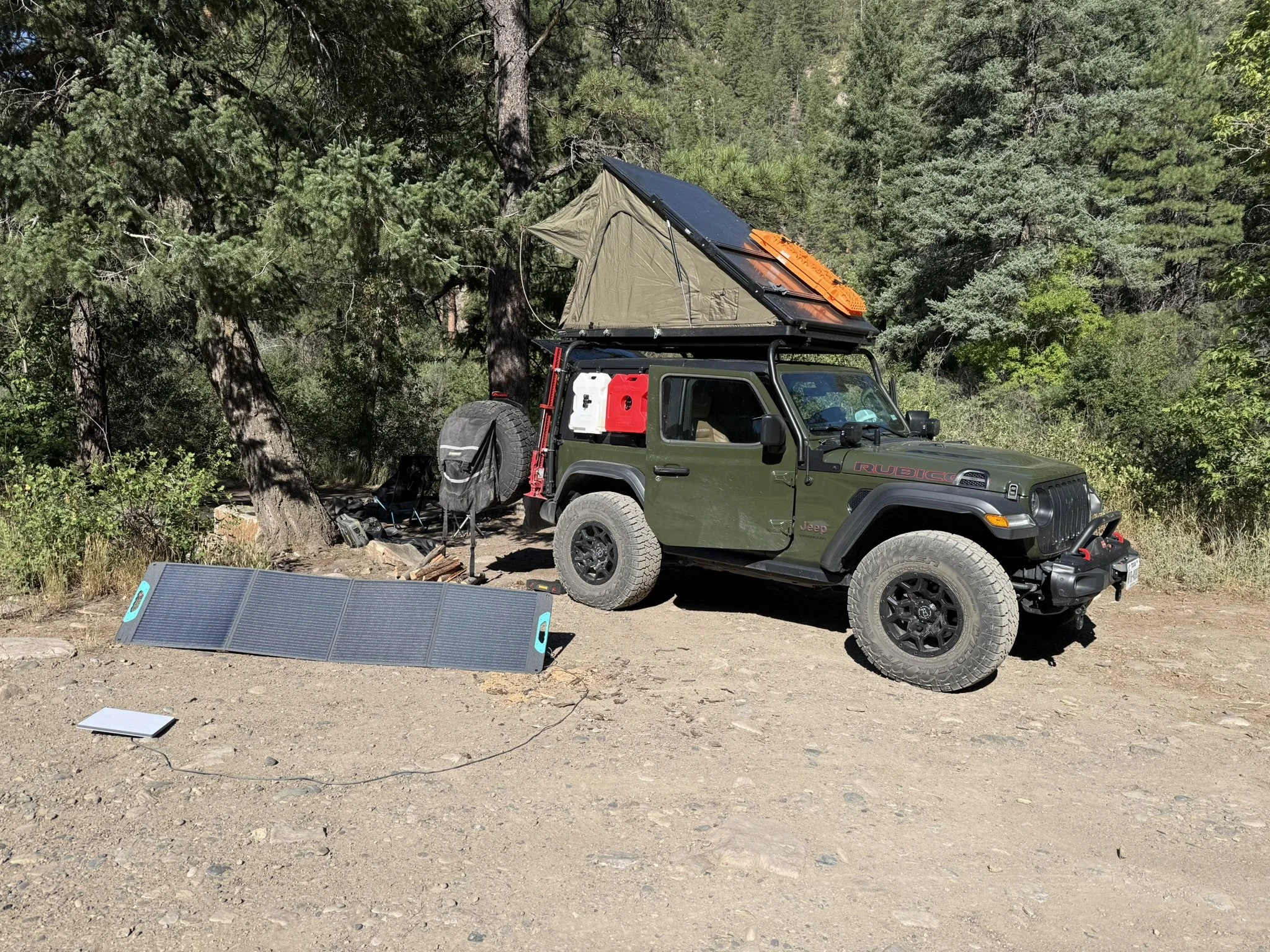
Starlink Mini at work, and charging the Anker Solix C1000 Power Station
As I mentioned in one of my blogs, I started using the OnX system and have never wanted to try much else afterwards. The premium membership gives me access to their trails, allows me to design my own, use GPS mapping through internet access, and still download local maps for when I don’t have internet access. I will admit there are times the system considers a recommended trail as existing through the middle of the woods, but it wasn’t hard to see where it really wanted me to go and to adjust.
INternet
My AT&T wireless has proven to beat Verizon at access in the mountains, but there have been many areas where there was no service. I have Starlink satellite service at my cabin in NM, and added their portable system for use in overlanding. What a difference! I can video stream with my wife, download maps, and even watch movies at night. The combination of Starlink with OnX rendered the Garmin system obsolete. On top of that my iPhone has texting via satellite capability which works much better than the Garmin InReach access. I added a mobile mount for the Starlink dish on top of my RTT, ran the cable down the rack and into the Jeep to get internet access while on the move. The cable runs off a USB-C connection, but needs to be the 3.0 or better (blue color in the USB-C port) for higher capacity power output. I have twice tripped on the cable when laying the dish beside the Jeep and broken the cable plug at the port. It’s too easy to break in my mind, but then I’m too clumsy too.
Power
Power banks are all the rage now, and are so incredibly useful. I started with a cheaper one for a few appliances, but the USB-C port wasn’t capable of handling my Starlink and it wouldn’t last through the night with my CPAP. (Another issue for the 50+ year old overlander). I upgraded to the Anker Solix C1000 model and it’s working fantastically. I generally keep it plugged into my Jeep to recharge it while driving (the plug I use isn’t on when the Jeep is off so no running the Jeep battery down). I run my CPAP and Starlink off it, as well as a camping appliance or two. I do have a 200 W solar panel I can lay out to recharge when stationary, but most of my recharging is handled from the Jeep while driving.
The Rubicon also has a 12v power plug in the back that runs off a second auxiliary battery located under the primary battery under the hood. (Most Jeep owners don’t even know it’s there). I run my electric refrigerator using it and have never had an issue with Jeep battery power the next morning.
KItchen
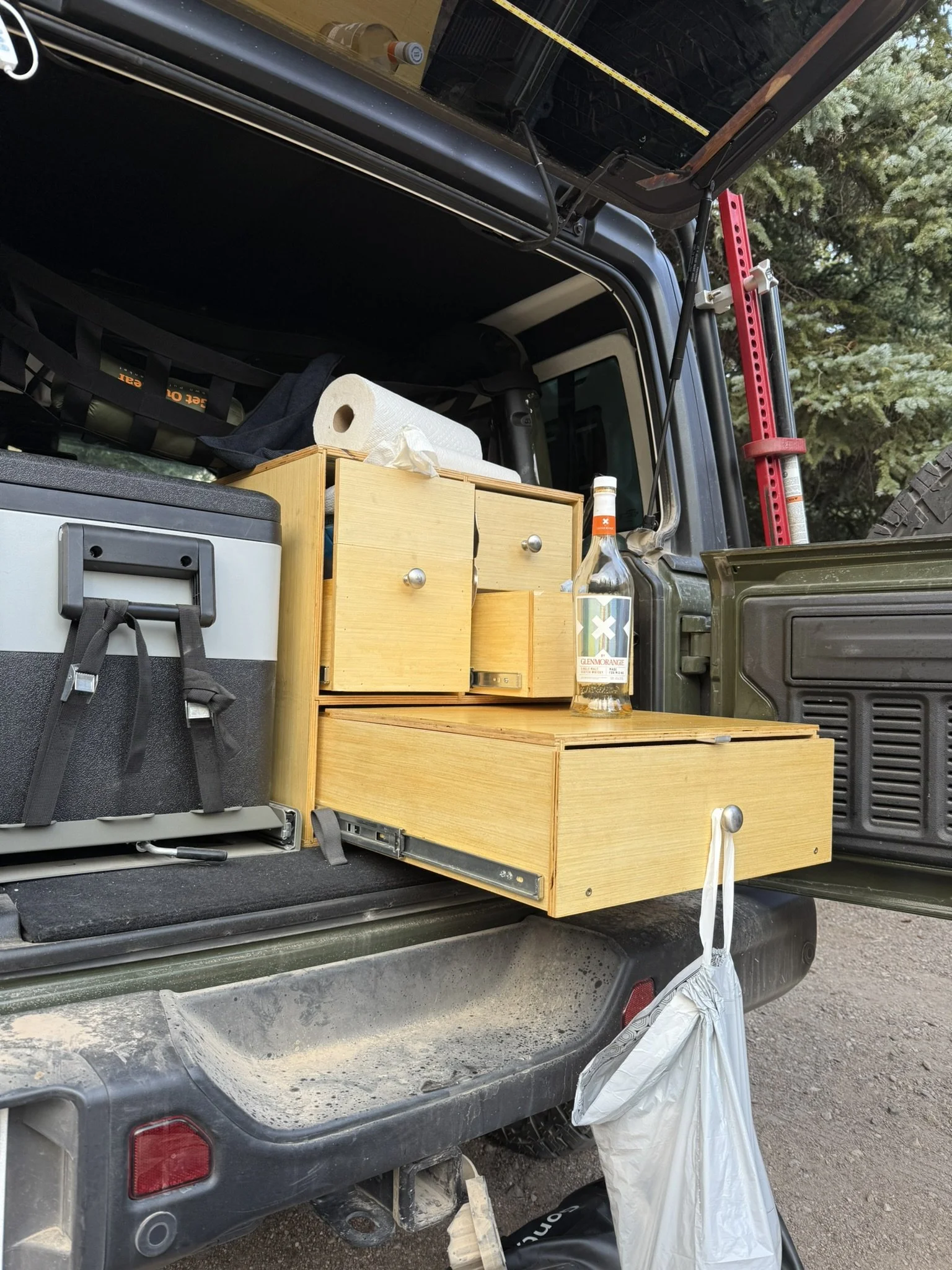
Setpower refrigerator and slideout next to camp kitchen
I built a homemade camp kitchen to store food and supplies in, and well as an extended stove drawer to cook from. It’s made from 1/2” plywood and has served me well for several years. I anchored it down by connecting it to a wood 2x2 at the back of the box and connecting the 2x2 to the anchor rings for the removed back seat. There was a tie-down ring screwed into the floor near the back door, so I bolted the other end of the box down using that threaded hole. It’s nicely anchored with no movement while driving over those rocky trails.
I also bought the SetPower PT35 dual zone 12v refrigerator that fits nicely next to my camp kitchen. I was very lucky there, as I built that camp kitchen box several years ago. I installed the SetPower slide mount and attached it to the same 2x2 as the kitchen box, as well as another point near the front. I plug the fridge into the rear 12v plug and have enough slack in the power line to roll it in and out without issue. The dual zone cooling works well too, keeping items well frozen in the smaller area. I need a place to keep ice for my scotch!